Is Newton safe? Our 2026 review
Updated November 2026. Checked against the regulators' registers and each platform's own pages.
Who pays us: Newton doesn't pay us. We have no affiliate or referral deals in place yet, so the link below earns us nothing. How we make money
The verdict
✓ Registered in Canada
Newton is registered with Canada's securities regulators and says it is now a CIRO dealer member. It makes its money on each trade, with published trading fees of 1.00% to 1.60% depending on the coin, and it doesn't charge to fund your account by e-Transfer.
- Registered as
- Restricted dealer on the register; CIRO dealer member per Newton
- Company
- Newton Crypto Ltd.
- Trading fee
- 1.00% to 1.60%, by coin
- e-Transfer funding
- No fee
- Crypto protected by CIPF
- No
Good
- Registered with the securities regulators, and says it joined CIRO in March 2026
- Publishes its trading fee for each group of coins
- No fee to fund by e-Transfer, and a no-fee lane for crypto withdrawals
- At least 80% of client crypto held in cold storage with outside custodians
Bad
- Trading fees of 1.00% to 1.60% are high next to flat-fee platforms
- The fee is part of the price, so you don't see it as a separate line on the fee page
- Keeps an unpublished share of staking rewards
Newton is a Canadian crypto platform that has never charged a separate commission. It earns its money in the price you pay. In 2026 it also moved into the most tightly supervised group of crypto platforms in the country.
Newton’s registration
The regulators’ register lists Newton Crypto Ltd. as a restricted dealer, with its latest decision dated 11 March 2026. That decision says Newton was registered as a restricted dealer in every province and territory and was working to become an investment dealer and a member of CIRO. The decision was set to end six months later, or sooner once Newton became a CIRO member.
Newton says that has now happened. A post on its blog, dated 20 March 2026, says Newton “is now registered as a CIRO dealer member.” Its relationship disclosure describes Newton as “an investment dealer registered in each province and territory of Canada.” When we checked, the register still showed the restricted dealer entry.
The notice at the foot of Newton’s pages says Newton Crypto Ltd. “is a Canadian company registered as a money services business with FINTRAC” and “a dealer member of the Canadian Investment Regulatory Organization (CIRO) and the Canadian Investor Protection Fund (CIPF).”

You can compare Newton with the other platforms on our registered list.
How Newton holds your crypto
Newton’s risk disclosure, last changed 27 March 2026, says at least 80% of client crypto sits in cold storage with two outside custodians: Coinbase Custody Trust Company LLC and BitGo Bank & Trust, N.A. Up to 20% is held online in hot wallets secured with software from Fireblocks Ltd. Each custodian holds the coins “in trust for clients of Newton” in a fully segregated account in Newton’s name.
Newton’s terms say crypto held in trust in your account is “beneficially owned by you and not by Newton.”
On insurance, the risk disclosure says Coinbase’s parent company carries US$320 million of insurance covering certain custody losses, and BitGo carries a $250 million policy. Fireblocks has US$30 million in total, shared among all its customers. Backup key material is guaranteed through a company called Coincover. The relationship disclosure warns that this insurance “may not be sufficient to cover all losses.”
Newton’s security page adds that it has completed a SOC 2 Type II audit and runs yearly outside penetration tests.
CIPF and CDIC don’t cover your crypto. Newton’s notice says crypto assets “are not protected by CIPF, the Canadian Deposit Insurance Corporation, or any other investor protection insurance scheme.” The pages we read don’t explain how CIPF applies to cash held in a Newton account.
Fees
Newton’s terms say it doesn’t charge account fees or maker and taker fees, and that “we do make money from the price spread at which you buy and we sell.” The relationship disclosure describes that spread as a trading fee added to the prices Newton gets from its liquidity providers.
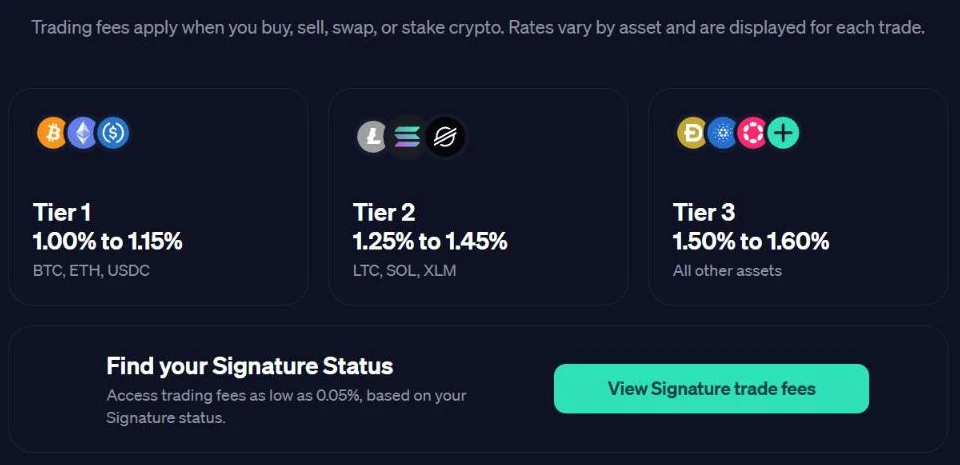
Newton’s fee page now publishes those trading fees by group of coins:
- Tier 1 (BTC, ETH, USDC): 1.00% to 1.15%
- Tier 2 (LTC, SOL, XLM): 1.25% to 1.45%
- Tier 3 (all other coins): 1.50% to 1.60%
The fee page says rates “are displayed for each trade.” It doesn’t use the word spread, and it doesn’t say which end of each range applies when. On a $1,000 Bitcoin buy, a 1.00% to 1.15% fee comes to $10 to $11.50. The page also says clients in its Signature program can get fees “as low as 0.05%,” without listing who qualifies.
One conflict to know about: Newton’s relationship disclosure says an affiliate, DV Chain (Canada) Inc., is one of its liquidity providers. Newton says it uses a smart order router and checks its prices against global prices.
If you stake, Newton keeps a share of the rewards. The pages we read don’t say how much.
Deposits and withdrawals
You can fund your account by Interac e-Transfer, wire or crypto. Newton’s get started page says “We don’t charge fees when you fund your account with e-transfer.” Its pages don’t give a wire fee either way.
Canadian dollars go back out by e-Transfer, direct bank deposit (EFT) or wire. The relationship disclosure says Newton doesn’t charge “commissions, withdrawal or other transaction fees for trading.” Its funding page doesn’t list a fee for any Canadian dollar method.
Newton’s limits page sets these caps:
- e-Transfer deposits: $10,000 per transaction and $70,000 a week.
- e-Transfer withdrawals: $10,000 per transaction.
- EFT withdrawals: $50,000 per transaction.
- e-Transfer and EFT withdrawals combined: $50,000 a week.
- Wire deposits and withdrawals: $1,000,000.
For Bitcoin and coins on the Ethereum network, crypto withdrawals come in three speeds. The fast lane costs $10 plus the network fee. The standard lane costs the network fee only. A third lane, meant for transfers that aren’t urgent, has no fee. Newton also covers up to $5 of network fees on your first crypto withdrawal each day.
Coins, app and investment limits
Newton’s home page says it offers “50+ assets.” You can trade in its iOS and Android apps or on the web. The limits page says you can start with as little as $50. Newton is generally open to Canadian residents aged 18 and over.
Platforms in Canada often cap how much non-eligible investors can buy of some coins each year. The Newton pages we could reach don’t state any such limits, and its help centre blocked our checks, so we haven’t listed any amounts.
Frequently asked questions
Is Newton legit?
Yes. Newton Crypto Ltd. is on the securities regulators’ register of crypto trading platforms, and Newton says it became a CIRO dealer member in March 2026. It is also registered with FINTRAC.
Is Newton safe?
No platform takes away the risk of crypto prices falling. Newton says at least 80% of client crypto sits in cold storage with Coinbase and BitGo, held in trust in a segregated account, and that its custodians carry insurance with limits.
How much does Newton charge?
Newton’s fee page lists trading fees of 1.00% to 1.60%, depending on the coin, built into the price. It doesn’t charge to fund by e-Transfer, and it has a no-fee lane for crypto withdrawals. Our comparison of registered exchanges shows how other platforms price their trades.
Is my crypto covered by CIPF on Newton?
No. Newton is a CIPF member, but its notice says crypto assets aren’t protected by CIPF, CDIC or any other investor protection scheme.
Sources
Checked 10 November 2026.
- Newton, fees and regulatory notice: trading fee tiers of 1.00% to 1.60%, Signature fees “as low as 0.05%”, FINTRAC, CIRO and CIPF notice
- Newton, relationship disclosure, last updated 18 March 2026: investment dealer in each province and territory, spread as a trading fee, no withdrawal fees for trading, DV Chain conflict, staking fee
- Newton, risk disclosure, last modified 27 March 2026: custodians, 80% cold storage, trust accounts, insurance amounts
- Newton, terms and conditions, last modified 5 March 2026: no account or maker and taker fees, spread, beneficial ownership
- Newton, security: SOC 2 Type II, penetration testing
- Newton, funding and withdrawals: funding methods, crypto withdrawal lanes, $5 daily network fee cover
- Newton, limits: deposit, withdrawal and trading limits, $50 starting amount
- Newton, get started: no fee for e-Transfer funding, age and residency
- Newton, home page: “50+ assets”, iOS and Android apps
- Newton, Newton is now a CIRO dealer member, 20 March 2026
- New Brunswick Financial and Consumer Services Commission, registered crypto asset trading platforms, and the linked Newton decision of 11 March 2026
Update history
- First published.
- First published.
Found something out of date? Tell us.