Fidelity crypto in Canada: who can use it?
Updated November 2026. Checked against the regulators' registers and each platform's own pages.
Who pays us: Fidelity doesn't pay us. We have no affiliate or referral deals in place yet, so the link below earns us nothing. How we make money
The verdict
✓ Registered in Canada
Fidelity's Canadian crypto service is run by a registered investment dealer and CIRO member, but it's built for portfolio managers, brokers and fund dealers. Individual Canadians can't open a crypto account with Fidelity. Fidelity's own pages point individuals to its bitcoin and ether ETFs instead.
- Registered as
- Investment dealer, CIRO member
- Company
- Fidelity Clearing Canada ULC
- Who it serves
- Portfolio managers, introducing brokers, fund dealers
- Open to individuals directly
- No
- Crypto protected by CIPF
- No
Good
- Investment dealer and CIRO member
- Cold, offline storage spread across several sites
- Fidelity's bitcoin and ether ETFs trade on the TSX
Bad
- No direct crypto account for individual Canadians
- Its digital asset pages publish no fees or minimums
- You can't move coins to your own wallet through the ETFs
Fidelity shows up on Canada’s list of registered crypto trading platforms, so it’s fair to ask whether you can buy bitcoin there. The short answer is no, not as an individual. Fidelity’s Canadian crypto service is for investment firms.
Fidelity’s registration
The regulators’ register lists Fidelity Clearing Canada ULC as an investment dealer, with its latest decision dated 14 April 2026. A second entry, Fidelity Digital Assets Services, LLC, is registered as an exempt marketplace and clearing agency. That one supports Fidelity’s Canadian business and doesn’t deal with the public.
The footer of Fidelity Clearing Canada’s digital assets page says Fidelity Clearing Canada ULC “is a member of the Canadian Investment Regulatory Organization (CIRO) and the Canadian Investor Protection Fund (CIPF).”
Investment dealer status is the higher of the two types of registration for crypto platforms in Canada. You can compare it with the other platforms on our registered list.
Who can use Fidelity’s crypto service
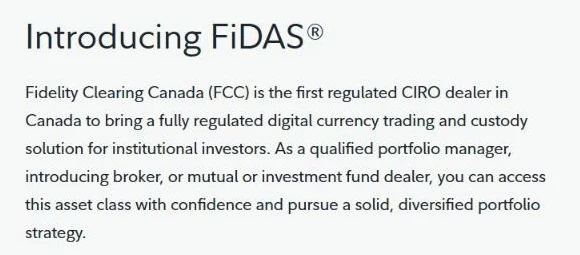
Fidelity’s crypto trading and custody service in Canada is called FiDAS. Its page speaks to firms, not to individuals. It addresses readers “as a qualified portfolio manager, introducing broker, or mutual or investment fund dealer.” Fidelity Clearing Canada’s home page lists its clients as portfolio managers, institutional introducing brokers, retail introducing brokers, and breakaway or independent advisors. It describes FiDAS as a way “for institutional investors to access Bitcoin and other digital asset trading.”
Neither page offers a sign-up for individuals. So if you’re an individual Canadian, you can’t open an account and buy crypto from Fidelity directly. A firm that uses Fidelity Clearing Canada may be able to offer crypto to its own clients, but that would be the firm’s offer, on its terms. Fidelity’s pages don’t list which firms do this.
How FiDAS holds crypto
The FiDAS page lists “offline, cold-vaulted storage”, “multi-site storage” and a “multi-tiered approval structure.” It doesn’t name a custodian, publish insurance details, or list which coins are available beyond bitcoin.
Fees
The FiDAS page doesn’t publish any fees, spreads or minimums, and Fidelity Clearing Canada’s home page doesn’t either.
What individuals can do instead
Fidelity’s Canadian site points individuals to funds that hold crypto, rather than to crypto itself. These are funds, so you own units, not coins.
- Fidelity Advantage Bitcoin ETF (FBTC). Its product page says it trades on the Toronto Stock Exchange, with a 0.32% management fee and a 0.35% MER as of 31 March 2026. It says at least 98% of the bitcoin is held in a cold wallet.
- Fidelity Advantage Ether ETF (FETH). Its product page says it also trades on the TSX, with a 0.43% MER as of 31 March 2026. The page gives two different management fee figures, so we haven’t quoted one.
- Fidelity Advantage Bitcoin ETF Fund. A mutual fund that holds the bitcoin ETF. Its fund page lists Series B and Series F.
Fidelity’s bitcoin FAQ says the funds “are eligible for registered accounts”, such as an RRSP or TFSA. It says the ETF may buy bitcoin through Fidelity Clearing Canada, its custodian, which buys from Fidelity Digital Assets in the US. You can’t swap ETF units for actual bitcoin.
Fidelity’s how to invest page gives two routes: through a financial advisor, or “through any online brokerage.” It doesn’t offer a way to buy from Fidelity directly.
Fidelity’s product pages describe the funds as high risk, and say crypto “historically demonstrated high volatility.” We don’t say whether any of them suits you. If you’d rather hold crypto itself, our registered list shows the platforms that take individual Canadians.
Frequently asked questions
Is Fidelity crypto legit?
Yes. Fidelity Clearing Canada ULC is registered with Canada’s securities regulators as an investment dealer and is a CIRO member. Its crypto service is for firms, though, not individuals.
Is Fidelity crypto safe?
Fidelity says FiDAS uses offline, cold storage across several sites. That’s a statement about how the coins are kept. It doesn’t protect anyone against a fall in price, and Fidelity’s own fund pages call crypto investments high risk.
How much does Fidelity charge for crypto?
The FiDAS page publishes no fees. For the funds, FBTC’s product page lists a 0.35% MER and FETH’s a 0.43% MER, both as of 31 March 2026. Your advisor or brokerage may charge its own fees on top.
Is Fidelity crypto covered by CIPF?
Not the crypto itself. CIPF’s FAQ says “crypto assets held by a CIPF member firm on your behalf are not covered by CIPF.” It does cover ETFs and mutual funds that invest in crypto, when they’re held with a CIPF member. CIPF protects against a member firm failing, not against losses in value.
Sources
Checked 10 November 2026.
- Fidelity Clearing Canada, FiDAS (digital assets): eligibility line for portfolio managers, introducing brokers and fund dealers; storage features; CIRO and CIPF footer notice; no fees or minimums shown
- Fidelity Clearing Canada, home: client types and FiDAS description
- Fidelity Investments Canada, Fidelity Advantage Bitcoin ETF: TSX listing, 0.32% management fee, 0.35% MER as of 31 March 2026, at least 98% in cold wallet
- Fidelity Investments Canada, Fidelity Advantage Ether ETF: TSX listing, 0.43% MER as of 31 March 2026
- Fidelity Investments Canada, Fidelity Advantage Bitcoin ETF Fund: holds the bitcoin ETF, Series B and F
- Fidelity Investments Canada, bitcoin ETF and mutual fund FAQ: registered account eligibility, custody chain, no redemption for bitcoin
- Fidelity Investments Canada, how to invest with Fidelity: advisor or online brokerage
- Canadian Investor Protection Fund, FAQ: crypto held by a member isn’t covered; crypto funds held with a member are
- New Brunswick Financial and Consumer Services Commission, registered crypto asset trading platforms
Update history
- First published.
- First published.
Found something out of date? Tell us.